
Certificación

ISO 13485 Quality Management System for Medical Devices
ISO 13485 is the international standard for Quality Management Systems for organizations involved in one or more stages of the medical device lifecycle: design, development, production, storage, distribution, installation, service, and disposal. It forms the basis for most medical device regulatory frameworks worldwide.
¿Qué es ISO 13485?
What is ISO 13485?
ISO 13485 establishes the requirements for a Quality Management System specifically for medical devices, focusing on risk management, traceability, regulatory compliance, and patient safety throughout the product lifecycle. Although derived from ISO 9001, it does not share the same structure: it excludes some requirements not applicable to the regulatory context of medical devices and incorporates industry-specific requirements.
It is applicable to manufacturers, suppliers, and organizations that provide services related to medical devices, regardless of their size. Many regulatory bodies worldwide (such as the FDA in the United States, Health Canada, or SAHPRA in South Africa) require or recognize ISO 13485 certification as a basis for regulatory compliance.

The conceptual basis
The pillars of ISO 13485
Focus on patient safety
All system requirements are geared towards ensuring that the medical device is safe and effective for its intended use.
Risk management throughout the life cycle
The standard requires applying risk management principles from the design stage to the final disposal of the product, not just during the production stage.
Traceability and regulatory control
It requires maintaining records and documentation that demonstrate compliance to regulators and health authorities in different markets.
International regulatory recognition
Unlike other management standards, ISO 13485 is directly linked to regulatory frameworks such as the European MDR, the FDA (QMSR) or the MDSAP program, making it a basis for access to multiple markets.
The structure of the standard
The chapters of ISO 13485
Scope
Define the scope of the standard and which organizations it is directed to.
Regulatory references
Indicate the reference documents necessary for the application of the standard.
Terms and definitions
It brings together the specific terms and definitions of the medical device sector used in the standard.
Quality Management System
It establishes the general system requirements, including documentation and the master file of the medical device.
Management responsibility
Define management commitment, customer focus, quality policy, and system planning.
Resource management
It covers the human resources, infrastructure, and work environment necessary to produce safe medical devices.
Product realization
It establishes the requirements for planning, design and development, purchasing, production and service delivery, including process validation.
Measurement, analysis and improvement
It requires monitoring customer satisfaction, conducting internal audits, controlling non-conforming product, and implementing corrective actions.
The value of the LSQA seal
We turn technical backing into trust
The LSQA seal is not just a document: it is visible proof that an organization went through a rigorous, objective audit process. When a client, business partner, or regulator sees it, they know it reflects years of certification experience across Latin America, strict technical criteria, and ongoing monitoring — not a self-assessment. That's why the seal becomes a business tool: it reduces the uncertainty of whoever chooses you and communicates, at a glance, a real commitment to quality.
Why certify
Benefits of ISO 13485 certification
It facilitates access to markets that require or recognize ISO 13485 as a regulatory basis (European Union, Canada, Singapore, South Africa, among others)
It reduces the risk of incidents related to the safety and efficacy of medical devices.
It aligns with key regulatory frameworks, such as the European MDR, the FDA (QMSR), and the MDSAP program.
It improves traceability and process control throughout the entire product lifecycle.
It builds trust with customers, distributors, regulators, and patients.
It facilitates risk management and the prevention of nonconformities in critical processes.

Your journey with LSQA
Certification Process
 Contact with LSQA
 I receive advice
 I provide the information needed for a quote
 I receive a quote
 I confirm the agreement by signing the contract
 Welcome to the LSQA network
 I am contacted to begin coordinating the service
 I meet the audit team for my confirmation
 I receive the audit plan
 Audit
Audit I receive the report
 If applicable, I receive the certificate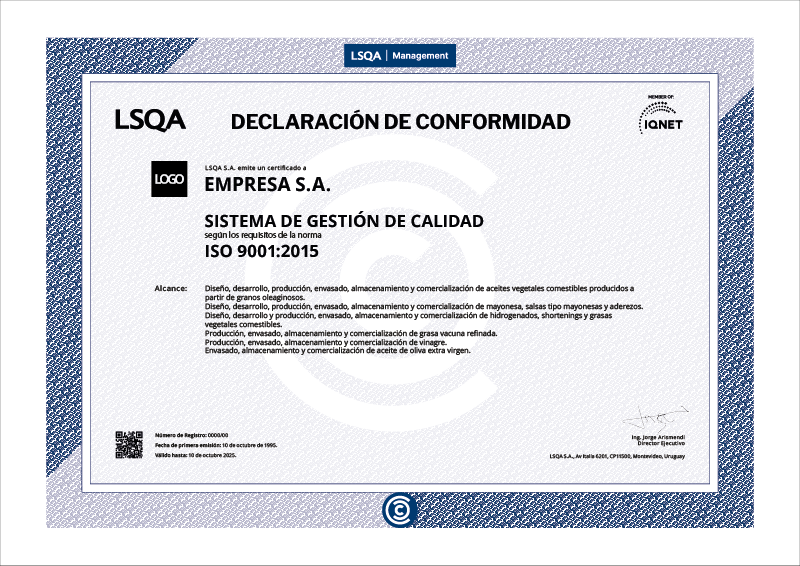
 My voice is heard
Preguntas frecuentes
What is ISO 13485 certification?
ISO 13485 certification verifies that an organization has a Quality Management System implemented in accordance with the requirements of the international standard ISO 13485:2016, specific for the design, development, production and marketing of medical devices.
What type of organizations does ISO 13485 apply to?
ISO 13485 applies to manufacturers, suppliers and organizations involved in one or more stages of the life cycle of a medical device, regardless of their size or the type of device they produce.
Does ISO 13485 replace local regulatory compliance?
No. ISO 13485 does not replace the legal requirements of each market, but it is designed to align with regulatory frameworks such as the European MDR or the FDA, facilitating compliance and access to those markets.
Why doesn't ISO 13485 follow the same structure as other ISO standards?
Unlike standards such as ISO 9001 or ISO 14001, ISO 13485 does not follow the High-Level Structure (Annex SL), as it was developed before that format was adopted. Therefore, it has an 8-chapter structure, with content specifically focused on medical devices.
How long does the ISO 13485 certification process with LSQA take?
The ISO 13485 certification process with LSQA, from application to certificate issuance, typically takes between two and four months, depending on the size and complexity of the organization. This timeframe includes service coordination, Stage 1 and Stage 2 audits, report preparation (up to 15 days after the audit), and, if applicable, the time for the organization to present and demonstrate the effectiveness of corrective actions for any nonconformities.
What is the validity period of the ISO 13485 certificate?
The ISO 13485 certificate is valid for three years. During this period, LSQA conducts annual follow-up audits to verify that the Quality Management System remains compliant with the standard's requirements. At the end of the three-year period, a recertification audit is performed to renew the certificate for another three-year term.
Certify your Medical Device Quality Management System with LSQA
Contact us and start your journey towards ISO 13485 certification