
Certificación

ISO 20000-1 Certification IT Services
ISO/IEC 20000-1 is the international benchmark standard for IT Service Management (ITSM). It establishes the requirements for planning, designing, transitioning, delivering, and continually improving IT services, ensuring that they meet business and customer requirements and generate value throughout the service lifecycle.

¿Qué es ISO 20000-1 Certification?
What is the ISO/IEC 20000-1 standard?
ISO/IEC 20000-1 defines the requirements for establishing, implementing, maintaining, and continually improving a Service Management System (SMS). It covers the entire service lifecycle: planning, design, transition, delivery, and improvement, including topics such as service level management, capacity, continuity and availability, supplier management, change management, incident and problem management, and information security.
It is applicable to any organization that manages or provides IT services, whether internally or as an external provider, and can be integrated with other certified management systems, such as ISO 9001 or ISO 27001.

The conceptual basis
The pillars of ISO/IEC 20000-1
Complete service lifecycle
The standard covers everything from the planning and design of services to their delivery, operation and continuous improvement, not just incident resolution.
Focus on customer value
The system is geared towards ensuring that IT services meet agreed requirements and generate real value for the business and end users.
Supply chain management
It includes specific requirements for managing multiple providers and service integrators, which are increasingly relevant in complex and outsourced IT environments.
High-Level Structure (Annex SL)
ISO/IEC 20000-1 shares the same structure as ISO 9001, ISO 14001 or ISO 27001, making it easier to integrate IT service management with other already certified systems.
The structure of the standard
The 10 chapters of ISO/IEC 20000-1
Scope
Define the scope of the standard and which organizations it is directed to.
Regulatory references
It brings together the specific terms and definitions of IT service management used in the standard.
Terms and definitions
It brings together the specific terms and definitions of IT service management used in the standard.
Organizational context
It requires identifying internal and external factors, and the needs of stakeholders, that influence service management.
Leadership
It establishes senior management's commitment to the service policy and the roles of responsibility.
Planning
Define service objectives, risk and opportunity management, and change planning in the Service Management System.
Support
It covers the resources, skills, communication, and documentation necessary to sustain the system.
Operation
It establishes operational planning, demand management, the service catalog, supplier management, capacity, availability, continuity, information security, changes, incidents, and problems.
Performance evaluation
It requires monitoring, measuring, analyzing, and auditing the performance of the service and the management system.
Improvement
It establishes the continuous improvement cycle based on non-conformities and the performance achieved in the provision of services.
The value of the LSQA seal
We turn technical backing into trust
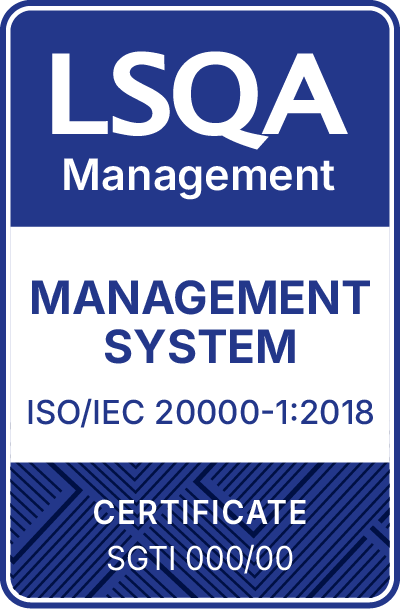
The LSQA seal is not just a document: it is visible proof that an organization went through a rigorous, objective audit process. When a client, business partner, or regulator sees it, they know it reflects years of certification experience across Latin America, strict technical criteria, and ongoing monitoring — not a self-assessment. That's why the seal becomes a business tool: it reduces the uncertainty of whoever chooses you and communicates, at a glance, a real commitment to quality.
Why certify
Benefits of ISO/IEC 20000-1 certification
Improve efficiency and quality in IT service delivery
Align IT services with the real needs of the business and customers
It reduces disruptions and improves the management of incidents, problems, and changes.
It strengthens supplier management and the service supply chain
It integrates easily with other certified management systems (ISO 9001, ISO 27001, etc.)
It builds trust with customers who require guarantees about the quality and continuity of service.

Your journey with LSQA
Certification Process
 Contact with LSQA
 I receive advice
 I provide the information needed for a quote
 I receive a quote
 I confirm the agreement by signing the contract
 Welcome to the LSQA network
 I am contacted to begin coordinating the service
 I meet the audit team for my confirmation
 I receive the audit plan
 Audit
Audit I receive the report
 If applicable, I receive the certificate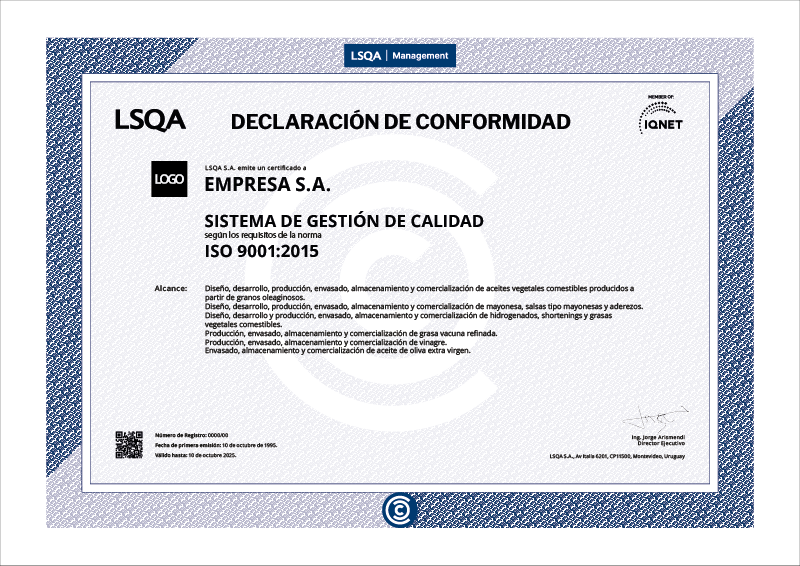
 My voice is heard
Preguntas frecuentes
What is ISO/IEC 20000-1 certification?
The ISO/IEC 20000-1 certification verifies that an organization has an IT Service Management System implemented in accordance with the requirements of the international standard ISO/IEC 20000-1:2018, focused on continuous improvement in the delivery of IT services.
To what type of organizations does ISO/IEC 20000-1 apply?
ISO/IEC 20000-1 applies to any organization that manages or provides IT services, whether internally, as an external provider, or as a service integrator within a supply chain.
What is the relationship between ISO/IEC 20000-1 and ITIL?
ISO/IEC 20000-1 establishes the certifiable requirements for a Service Management System, while ITIL is a framework of best practices that many organizations use as a guide to implement the processes required by the standard. Using ITIL is not mandatory for ISO/IEC 20000-1 certification, but they are often complementary.
Can ISO/IEC 20000-1 be integrated with other already certified standards?
Yes. By following the High-Level Structure (Annex SL), ISO/IEC 20000-1 integrates easily with existing management systems, such as ISO 9001 for quality or ISO 27001 for information security.
What is the validity period of the ISO/IEC 20000-1 certificate?
The ISO/IEC 20000-1 certificate is valid for three years. During this period, LSQA conducts annual follow-up audits to verify that the IT Service Management System remains compliant with the standard's requirements. At the end of the three-year period, a recertification audit is performed to renew the certificate for another three-year term.
Certify your IT Service Management System with LSQA
Contact us and start your journey towards ISO/IEC 20000-1 certification