
Certificación

ISO 14001 Certification Environmental Management System
ISO 14001 is the international benchmark standard for environmental management. Certifying with LSQA demonstrates to customers, authorities, and the community that your organization systematically identifies, controls, and reduces its environmental impact, backed by an accredited certification body with regional presence across Latin America.

¿Qué es ISO 14001 Certification?
Managing impact, not just compliance
ISO 14001 is part of the ISO 14000 family of standards and specifies the requirements for an Environmental Management System (EMS). It does not certify a specific level of environmental performance; rather, it certifies that the organization has processes capable of identifying its environmental aspects, controlling their impacts, and systematically improving them.
That is why it relies on the Plan-Do-Check-Act (PDCA) cycle: each environmental process is planned, executed, measured and adjusted in a continuous improvement loop.
Base conceptual
The core concepts of environmental management
Environmental aspect and impact
An environmental aspect is the element of an activity, product, or service that interacts with the environment; the impact is the change that aspect causes. Identifying them is the foundation of the entire system.
Life cycle perspective
Environmental impact is assessed from raw material acquisition through final disposal, not only within the organization's facilities.
Compliance obligations
The organization must know and fulfill applicable legal requirements and the environmental commitments it voluntarily assumes.
Risk-based thinking
The system is planned by identifying environmental risks and opportunities, in order to prevent unwanted effects before they occur.
Leadership and commitment
Top management must take direct responsibility for the effectiveness of the system, integrate it into business processes, and ensure the necessary resources.
Continual improvement cycle (PDCA)
The system is planned, implemented, checked, and adjusted continuously, in a loop that does not end with the first audit.
Structure of the standard
The 10 chapters of the standard
Scope
Defines the scope of the EMS and its applicability to the organization.
Normative references
Documents indispensable for the application of the standard.
Terms and definitions
Environmental management vocabulary used throughout the standard.
Context of the organization
Identification of internal, external, and interested-party issues relevant to the environment.
Leadership
Top management commitment, environmental policy, and defined roles.
Planning
Identification of environmental aspects, risks, compliance obligations, and environmental objectives.
Support
Resources, competence, awareness, communication, and documented information.
Operation
Operational planning and control of processes with environmental impact, including emergency preparedness.
Performance evaluation
Monitoring, measurement, analysis, internal audit, and management review.
Improvement
Handling non-conformities, corrective actions, and continual improvement of the EMS.
El valor del sello de LSQA
Convertimos respaldo técnico en confianza
El sello LSQA no es solo un documento: es la prueba visible de que una organización pasó por un proceso de auditoría exigente y objetivo. Cuando un cliente, un socio comercial o un regulador lo ve, sabe que detrás hay años de trayectoria certificando en toda América Latina, criterios técnicos rigurosos y seguimiento constante — no una autoevaluación. Por eso el sello se convierte en una herramienta comercial: reduce la incertidumbre de quien te elige y comunica, de un vistazo, un compromiso real con la calidad.
Why get certified?
Concrete benefits, not just the certificate
Reduces the environmental impact of operations and legal non-compliance risks.
Optimizes resource use (energy, water, raw materials) and lowers waste-related costs.
Improves the organization's image before customers, authorities, and the community.
Facilitates access to markets and tenders that require certified environmental management.
Builds a culture of continual improvement and pollution prevention.

Your journey with LSQA
Certification Process
 Contact with LSQA
 I receive advice
 I provide the information needed for a quote
 I receive a quote
 I confirm the agreement by signing the contract
 Welcome to the LSQA network
 I am contacted to begin coordinating the service
 I meet the audit team for my confirmation
 I receive the audit plan
 Audit
Audit I receive the report
 If applicable, I receive the certificate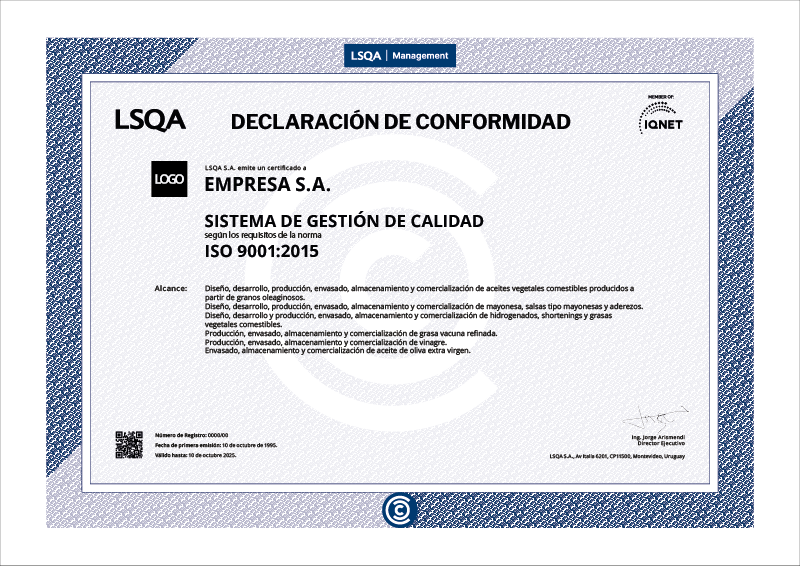
 My voice is heard
Preguntas frecuentes
What is ISO 14001 certification?
ISO 14001 is the international standard that establishes the requirements for an Environmental Management System (EMS). It certifies that an organization systematically identifies, controls, and reduces the environmental impact of its activities through continuous improvement.
How long does the ISO 14001 certification process take?
The entire process typically takes between 3 and 6 months, depending on the size of the organization and the prior development of its environmental management system. It includes initial consultation, certification audit, and certificate issuance.
How long is the ISO 14001 certificate valid?
The certificate is valid for 3 years, with annual follow-up audits that verify that the environmental management system remains in compliance with the standard.
Which companies need to be ISO 14001 certified?
Any organization that wants to formally manage its environmental impact can become certified, regardless of its size or sector. This is especially relevant in industries with high resource consumption, waste generation, or emissions, and in companies that participate in supply chains that require this certification from their suppliers.
Is ISO 14001 certification mandatory?
No, it's a voluntary certification. However, many corporate clients, public tenders, and export markets require it, so in practice it becomes a business condition in several sectors.
Does ISO 14001 guarantee that a company does not pollute?
Not exactly: the standard doesn't set emission limits or guarantee zero environmental impact. It certifies that the organization has a management system capable of identifying its impacts, complying with current environmental regulations, and continuously improving its performance over time.
Ready to certify your environmental management system?
Tell us about your organization and we'll contact you for the next steps.