

Certificación

ISO 45001 Certification Occupational Health and Safety Management
ISO 45001 is the international benchmark standard for occupational health and safety management. Certifying with LSQA demonstrates to workers, authorities, and customers that your organization systematically identifies and controls workplace risks, backed by an accredited certification body with regional presence across Latin America.
¿Qué es ISO 45001 Certification?
Preventing harm, not just responding to it
ISO 45001 specifies the requirements for an Occupational Health and Safety Management System (OHSMS). It does not certify the total absence of risk; rather, it certifies that the organization has processes capable of identifying hazards, assessing risks, and controlling them before they result in a workplace accident or illness.
Therefore, it relies on the Plan-Do-Check-Act (PDCA) cycle: each safety process is planned, implemented, measured, and adjusted in a continuous improvement loop.

Conceptual basis of the standard
The core concepts of occupational health and safety
Hazard and workplace risk
Identifying sources of potential harm (hazards) and assessing the likelihood and severity of that harm occurring (risk) is the foundation of the entire system.
Hierarchy of controls
Risks are controlled in order of priority: first eliminate the hazard, then substitute it, then engineering controls, administrative controls, and, as a last resort, personal protective equipment.
Leadership and worker participation
Top management takes direct responsibility for safety, and workers themselves participate in hazard identification and in decisions that affect them.
Risk-based thinking
The system is planned by identifying safety risks and opportunities, in order to prevent accidents before they occur.
Compliance obligations
The organization must know and fulfill the applicable occupational health and safety legal requirements in each country where it operates.
Continual improvement cycle (PDCA)
The system is planned, implemented, checked, and adjusted continuously, incorporating lessons learned from every incident or near-miss.
Structure of the standard
The 10 chapters of the standard
Scope
Defines the scope of the OHSMS and its applicability to the organization.
Normative references
Documents indispensable for the application of the standard.
Terms and definitions
Occupational health and safety vocabulary used throughout the standard.
Context of the organization
Identification of internal, external, and interested-party issues relevant to occupational health and safety.
Leadership and worker participation
Top management commitment, OH&S policy, and active worker consultation.
Planning
Hazard identification, risk and opportunity assessment, and OH&S objectives.
Support
Resources, competence, awareness, communication, and documented information.
Operation
Operational planning and control, hierarchy of controls, and emergency preparedness.
Performance evaluation
Monitoring, measurement, incident investigation, internal audit, and management review.
Improvement
Handling incidents and non-conformities, corrective actions, and continual improvement of the OHSMS.
El valor del sello de LSQA
Convertimos respaldo técnico en confianza
El sello LSQA no es solo un documento: es la prueba visible de que una organización pasó por un proceso de auditoría exigente y objetivo. Cuando un cliente, un socio comercial o un regulador lo ve, sabe que detrás hay años de trayectoria certificando en toda América Latina, criterios técnicos rigurosos y seguimiento constante — no una autoevaluación. Por eso el sello se convierte en una herramienta comercial: reduce la incertidumbre de quien te elige y comunica, de un vistazo, un compromiso real con la calidad.
WHY GET CERTIFIED
Concrete benefits, not just the certificate
Access to tenders and clients that require ISO 45001 as a qualification requirement
Fewer accidents, absenteeism, and days lost due to work-related incidents
Reduced legal exposure to inspections and claims related to workplace safety
Workers more committed to a real culture of prevention
Common basis for integrating other management standards (ISO 9001, ISO 14001) in the future

Process with LSQA
Certification Process
 Contact with LSQA
 I receive advice
 I provide the information needed for a quote
 I receive a quote
 I confirm the agreement by signing the contract
 Welcome to the LSQA network
 I am contacted to begin coordinating the service
 I meet the audit team for my confirmation
 I receive the audit plan
 Audit
Audit I receive the report
 If applicable, I receive the certificate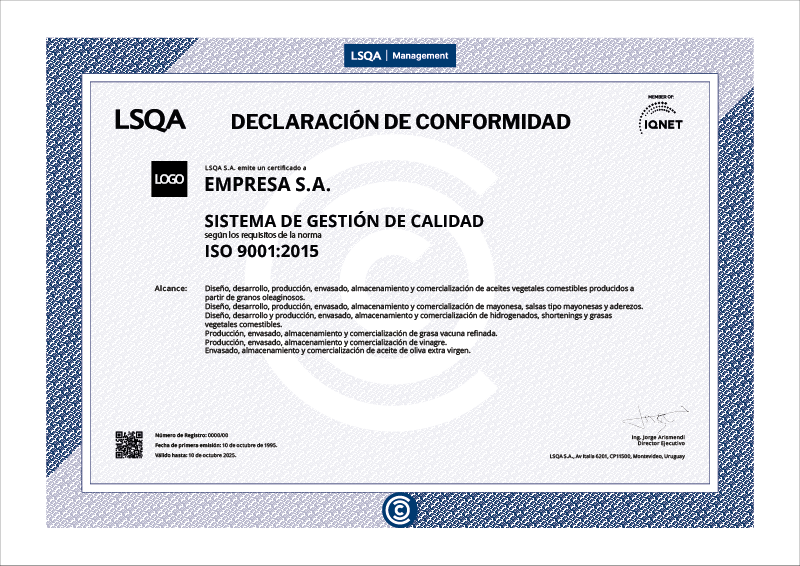
 My voice is heard
Preguntas frecuentes
What is ISO 45001 certification?
ISO 45001 is the international standard that establishes the requirements for an Occupational Health and Safety Management System (OHSMS). It certifies that an organization identifies workplace hazards, prevents accidents and occupational illnesses, and continuously improves working conditions.
How long does the ISO 45001 certification process take?
The entire process usually takes between 3 and 6 months, depending on the size of the organization and how developed its occupational health and safety management system is at the start.
The entire process usually takes between 3 and 6 months, depending on the size of the organization and how developed its occupational health and safety management system is at the start.
The certificate is valid for 3 years, with annual follow-up audits that verify that the system remains compliant with the standard.
Which companies need to be certified in ISO 45001?
Any organization, regardless of size or sector, can become certified. This is especially relevant in industries with greater exposure to workplace hazards (construction, manufacturing, logistics), and in companies that need to demonstrate a formal commitment to worker safety to clients or bidders.
Is ISO 45001 certification mandatory?
No, it's a voluntary certification. Each country's labor laws require certain minimum safety standards, but ISO 45001 certification goes further: it demonstrates a formal management system, audited by an independent third party.
What is the difference between ISO 45001 and OHSAS 18001?
OHSAS 18001 was the predecessor standard for occupational health and safety management, and was replaced by ISO 45001 in 2018. ISO 45001 incorporates a more integrated approach with other management standards (such as ISO 9001 and ISO 14001) and places greater emphasis on leadership and worker involvement.
Ready to certify your people's safety?
Tell us about your organization and we'll contact you for the next steps.