

Certificación

ISO 9001 Quality Management System
The world's most widely adopted quality management standard, applicable to organizations of any size and sector that want to demonstrate their ability to deliver products and services consistently.

¿Qué es ISO 9001?
A system, not a photo
ISO 9001 is part of the ISO 9000 family of standards and specifies the requirements for a Quality Management System (QMS). It does not certify a specific product; rather, it certifies that the organization has processes capable of producing consistent results, identifying deviations, and systematically correcting them.
Therefore, it relies on the Plan-Do-Check-Act (PDCA) cycle: each process is planned, implemented, measured, and adjusted in a loop that does not end with the first audit.

Conceptual basis of the standard
The 7 principles of quality management
Customer focus
Understanding the present and future needs of customers in order to consistently exceed their expectations.
Leadership
Management establishes unity of purpose and creates the conditions for people to become involved in quality objectives.
People's commitment
Competent and committed people at all levels increase the ability to generate value.
Process approach
Manage activities as interrelated processes that function as a coherent system.
Improvement
Continuous improvement is a permanent goal of the system, not a one-off action in response to a problem.
Evidence-based decisions
Effective decisions are based on the analysis of data and information, not on assumptions.
Relationship management
Sustained performance depends on managing relationships with suppliers and other stakeholders effectively.
Structure of the standard
The 10 chapters of the standard
Scope
Defines the scope of the EMS and its applicability to the organization.
Normative references
Documents indispensable for the application of the standard.
Terms and definitions
Environmental management vocabulary used throughout the standard.
Organizational context
Identification of internal/external issues and stakeholders relevant to the management system.
Leadership
Management commitment, quality policy, and assignment of roles and responsibilities.
Planning
Actions to address risks and opportunities, and definition of measurable quality objectives.
Support
Resources, competence, awareness, communication, and documented information.
Operation
Planning and control of processes for the provision of products and services.
Performance evaluation
Monitoring, measurement, internal audit and management review.
Improvement
Handling non-conformities, corrective actions and continuous improvement of the system.
The value of the LSQA seal
We turn technical support into trust.
The LSQA seal is more than just a document; it's visible proof that an organization has undergone a rigorous and objective audit process. When a client, business partner, or regulator sees it, they know it represents years of experience certifying throughout Latin America, rigorous technical criteria, and continuous monitoring—not a self-assessment. That's why the seal becomes a powerful business tool: it reduces uncertainty for those who choose you and communicates, at a glance, a genuine commitment to quality.
Your journey with LSQA
Certification Process
 Contact with LSQA
 I receive advice
 I provide the information needed for a quote
 I receive a quote
 I confirm the agreement by signing the contract
 Welcome to the LSQA network
 I am contacted to begin coordinating the service
 I meet the audit team for my confirmation
 I receive the audit plan
 Audit
Audit I receive the report
 If applicable, I receive the certificate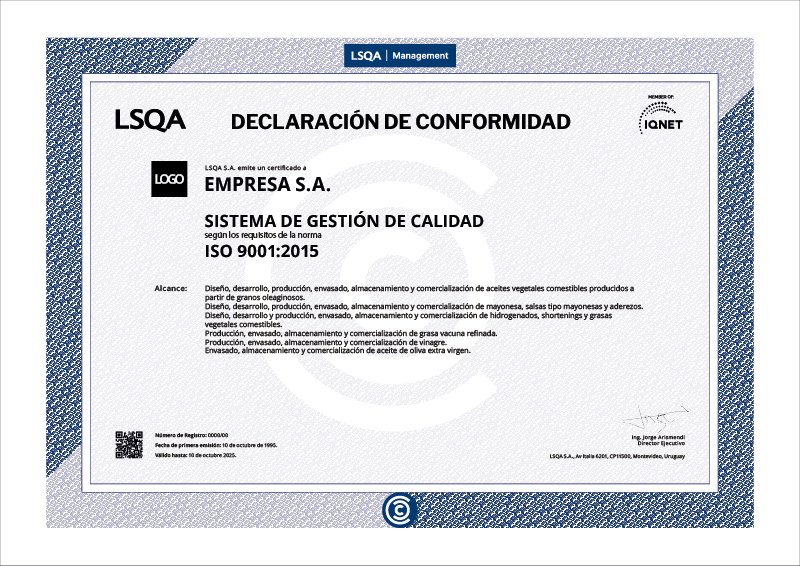
 My voice is heard
Preguntas frecuentes
How long does the ISO 9001 certification process take?
The entire process typically takes between three and six months, depending on the size of the organization and the level of development of its quality management system at the start. It includes the preliminary consultation phase, the certification audit, and the issuance of the certificate.
How long is the ISO 9001 certificate valid?
The certificate is valid for 3 years. During that period, LSQA conducts annual follow-up audits to verify that the management system remains compliant with the standard.
Which companies can be certified in ISO 9001?
Any organization, regardless of its size, sector, or activity, can be certified to ISO 9001. The standard is designed to adapt to both small businesses and large corporations, in industry, services, or commerce.
Is ISO 9001 certification mandatory?
No, ISO 9001 certification is voluntary. However, many public tenders and corporate clients require it as a qualification requirement, so in practice it becomes a business condition in several sectors.
What is the difference between ISO 9001 and ISO 9000?
ISO 9000 describes the fundamental concepts, principles, and vocabulary of quality management, while ISO 9001 is the certifiable standard: it establishes the specific requirements that an organization must meet to obtain certification.
What happens if the certification audit is not passed?
If nonconformities are detected, the organization is given a deadline to implement corrective actions. Once these are corrected, their closure is verified and, if applicable, the certificate is issued without having to repeat the entire process from scratch.
Ready to certify your management system?
Tell us about your organization and we will contact you for next steps.